Why Are My Gutters Sagging? Slope, Fasteners, and Summer Heat in Glen Rose, TX
Sagging gutters are a symptom, not the problem. The five things that actually cause it, why slope is the cause almost nobody checks, and how to tell a repair from a replacement.
Have a gutter question about your Granbury home?
Call (817) 326-3682A sagging gutter is not a problem. It is a symptom, and the difference matters because people keep treating the symptom.
The usual move is to push the low spot back up and drive a new screw through it. That holds for a season. Then it sags again, in the same place, because whatever pulled it down in the first place is still there.
Glen Rose makes this worse than most places. Homes here range from historic in-town properties to acreage along the river, and river-adjacent properties see more moisture exposure, which speeds up fastener and seam failure. Combine that with older homes near downtown that often have irregular rooflines, and you get a lot of gutter hanging on hardware that is working harder than it was designed to.
Here is what is actually happening when a gutter sags, how to tell which cause you have, and what it takes to fix it for good. For a free on-site evaluation, call (817) 326-3682.
What Sagging Actually Tells You
A gutter is a long horizontal object holding a heavy liquid, fastened to a board at one edge and nothing at the other. Every sag is a failure of one of three things: the fastener, the board the fastener goes into, or the load the system was asked to carry.
That is the whole diagnostic tree. Everything below is a branch of it.
The reason this matters: a sag caused by rotten fascia and a sag caused by too few hangers look identical from the driveway. They need completely different work. Guess wrong and you pay twice.
The Five Causes of a Sagging Gutter
1. Standing Water and Debris Weight
Water weighs a little over eight pounds per gallon. A clogged forty-foot run holding standing water along its length is carrying serious weight that the hangers were never sized for, and it carries it continuously rather than in the brief pulses of a rainstorm.
Tree-covered lots near the Paluxy River collect more seasonal debris, which is why this cause is overrepresented here. The clog holds water, the water bends the gutter, the bend creates a lower spot, the lower spot collects more debris. It compounds.
This is the cheapest cause to fix and the most common. If your gutter started sagging and you cannot remember the last time it was cleared, start there. Gutter cleaning and inspection will tell you whether weight was the whole story.
2. Fastener Failure
Screws and spikes back out. This is normal, not defective. The fascia board expands and contracts through the seasons, and every cycle works the fastener a fraction looser. Do that a few hundred times over fifteen years and the hardware is holding by friction alone.
Older spike-and-ferrule systems are the worst offenders. They rely on a single long nail driven through the gutter into the fascia, and once that hole is enlarged the nail will never hold properly again in the same spot.
Moisture accelerates all of it, which is the Glen Rose problem exactly.
3. Too Few Hangers, or the Wrong Kind
Some gutters sag because nobody ever put enough hardware on them. A run installed with hangers spaced too far apart will sag eventually no matter how well each individual hanger is fastened, because the gutter between them is unsupported and aluminum is soft.
You can spot this one: the sag appears midway between two visible hangers rather than at the hanger itself. The metal is bending, not the hardware failing.
4. Incorrect Slope
This is the cause almost nobody checks, and it is covered in its own section below because it is the one most likely to be misdiagnosed as something else.
5. Fascia Damage
If the board behind the gutter has gone soft, nothing fastened to it will hold. You can install the best hangers made, correctly spaced, and they will pull straight out of rotten wood.
This is the cause that turns a small job into a real one, and it is why we look behind the gutter rather than just at it. We repair the actual cause, not just the visible leak.
Slope: The Cause Almost Nobody Checks
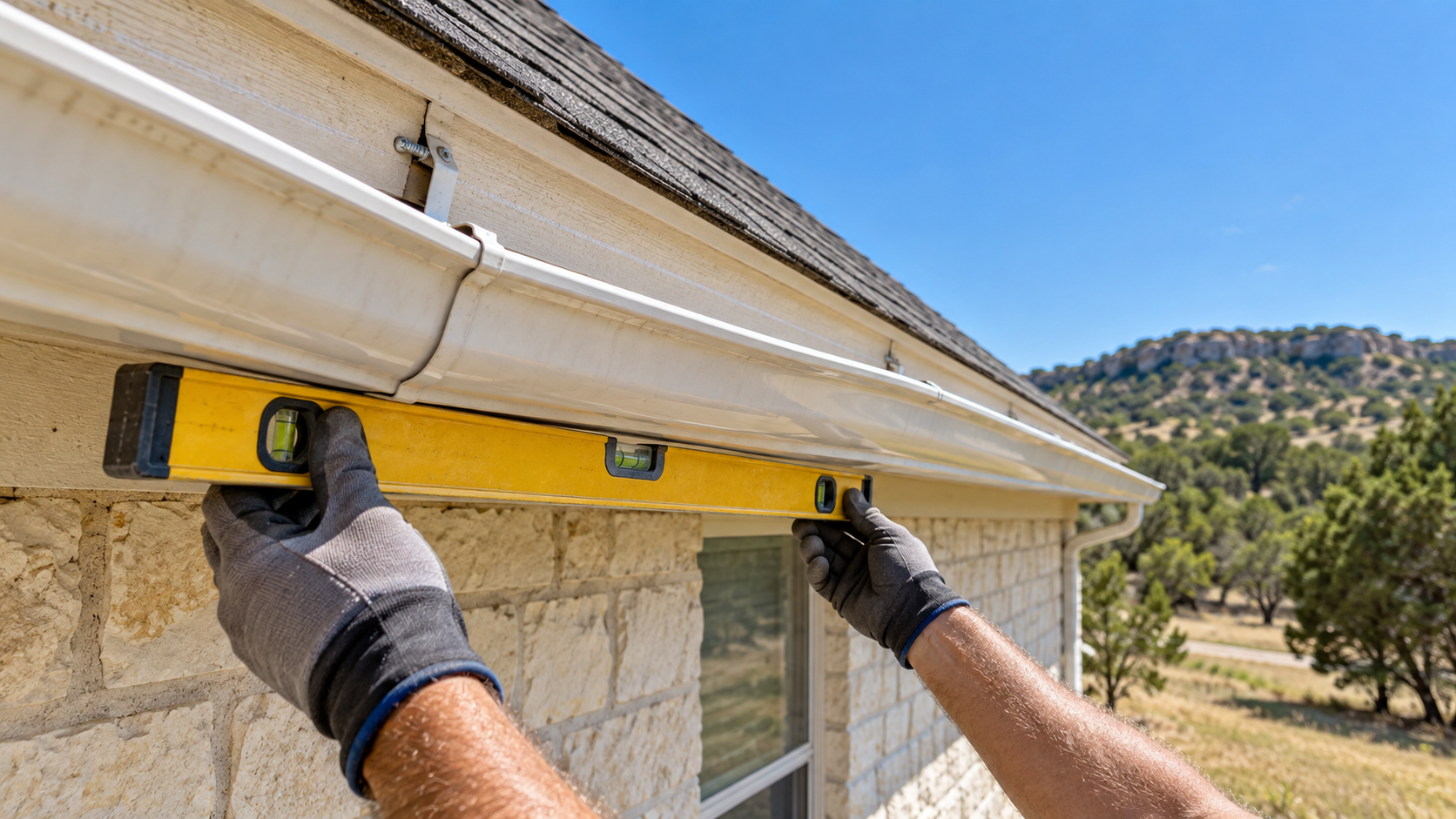
A gutter is not level. It is supposed to run slightly downhill toward the downspout, so water leaves rather than sits. That pitch is subtle enough that you cannot see it from the ground, which is exactly why it gets missed.
When slope is wrong, water pools in the low section permanently. Not during a storm — always. That standing water adds constant load in one spot, and the gutter deforms around it. The homeowner sees a sag and assumes a hanger failed. The hanger is fine. The gutter was hung wrong, or it settled out of pitch, and the sag is the consequence rather than the cause.
How to tell: look for a dirt or mineral line inside the gutter that sits below the rest of the run, or a section that is still holding water two days after rain. Standing water in dry weather is slope, not clogging.
Fixing it means rehanging the affected run to correct pitch, not shimming the low spot. On homes with irregular rooflines — common on older Glen Rose properties — slope has to be worked out section by section against where the downspouts actually are, which is part of why we measure at the house rather than quoting from an address.
Older homes near downtown Glen Rose often have irregular rooflines that benefit from a seamless system fabricated on-site to the exact measurements. A run formed to the actual length of the roofline can be hung to correct pitch in one continuous piece, which is considerably easier to get right than a sectional run assembled from stock lengths.
Why Summer Is When You Notice It
Sagging does not start in July. July is just when it becomes visible.
Two things happen in a North Texas summer. First, aluminum expands and contracts through a wide daily temperature swing, and every cycle puts a little more work into loosening fasteners. A gutter baking at surface temperatures far above the air temperature at three in the afternoon and cooling off overnight is being flexed every single day.
Second, and more usefully: the gutters are dry and empty. Sagging is far easier to see in a dry gutter than one full of water and debris, because nothing is disguising the line. The same run that looked acceptable in April reads obviously crooked in July against a straight roofline.
That makes midsummer the best inspection window of the year. Storm season has already done its damage and revealed the weak points, and you still have months before the next heavy rain to get the work done. Waiting until the gutter fails during an October downpour means fixing it in the rain, and it means whatever water escaped in the meantime has been running somewhere it should not.
Seams, Leaks, and Why They Travel Together
A leaking seam and a sagging run are usually the same story at different stages.
A sectional gutter is joined at seams, and every seam is a place where two pieces of metal meet with sealant between them. When a run sags, the geometry at those joints changes. The sealant is not designed to stretch, so it separates, and the seam starts weeping.
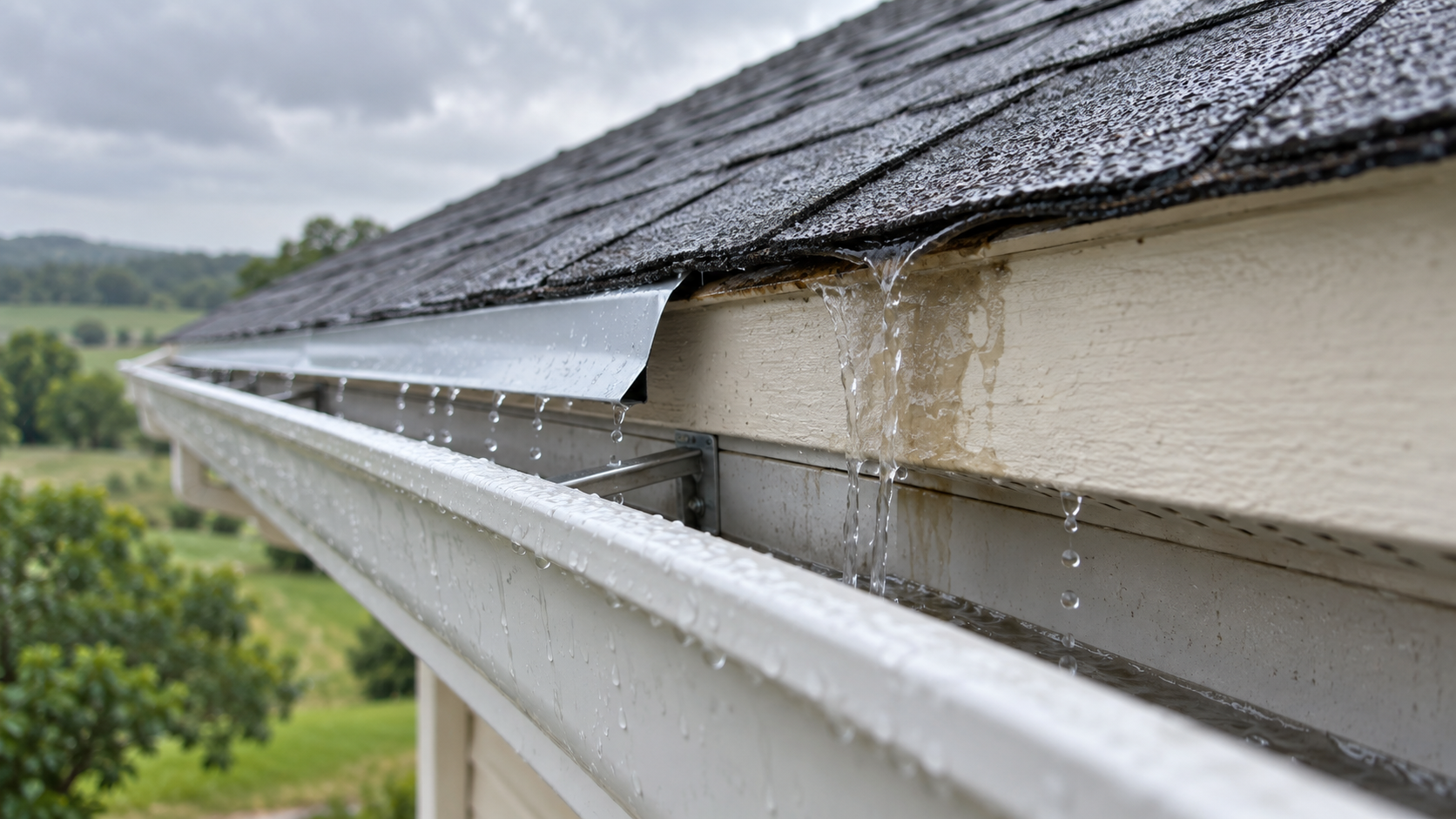
Then the leak accelerates the sag. Water escaping at a joint runs down the back of the gutter onto the fascia, the fascia softens, the fasteners in that softened board lose their grip, and the run drops further. That loop can take a season or it can take a decade, depending on how wet the wood gets and how often.
Resealing a seam on a run that is out of pitch buys you months. The seam will open again because the thing that opened it has not changed.
This is the strongest practical argument for seamless. Seamless gutter installation removes the seams from the middle of the run entirely — the gutter is formed to the exact length of each section of roofline, so there is no joint in the span to open up.
How Long Should Aluminum Gutters Last
Aluminum is our standard material, and a properly installed aluminum system is a long-term component of the house rather than a consumable. It does not rust, and the failure modes are mechanical — fasteners, fascia, slope, and physical damage — rather than the material itself giving up.
What that means in practice: if your aluminum gutters are sagging, the aluminum is very rarely the thing that failed. The hardware holding it up failed, or the wood behind it did. That is good news, because both are fixable without replacing the entire system.
The honest exception is a run that has been bent, patched, and re-screwed repeatedly over many years. Aluminum work-hardens and deforms permanently. Once a section has been pushed back into shape more than a couple of times, the metal itself is carrying kinks that will not come out, and it will keep failing at those points.
We will tell you which situation you are in when we look at it, rather than quoting a lifespan number that has nothing to do with your house.
What a Real Gutter Inspection Covers
An inspection that only looks at the gutter is not an inspection. What should be checked:
- The fascia behind the gutter, probed for softness rather than judged by appearance — paint hides a great deal of rot
- Fastener type, spacing, and grip, including whether the existing holes are still sound
- Slope across each run, measured rather than eyeballed, and checked against actual downspout placement
- Every seam and end cap for separation, not just the ones visibly dripping
- Downspout flow, confirmed by running water through, and where that water discharges
- The drip edge and roof edge, since water getting behind the gutter is often a roof-edge problem rather than a gutter problem
- Hanger condition, because hangers corrode and fatigue even when the gutter above them looks fine
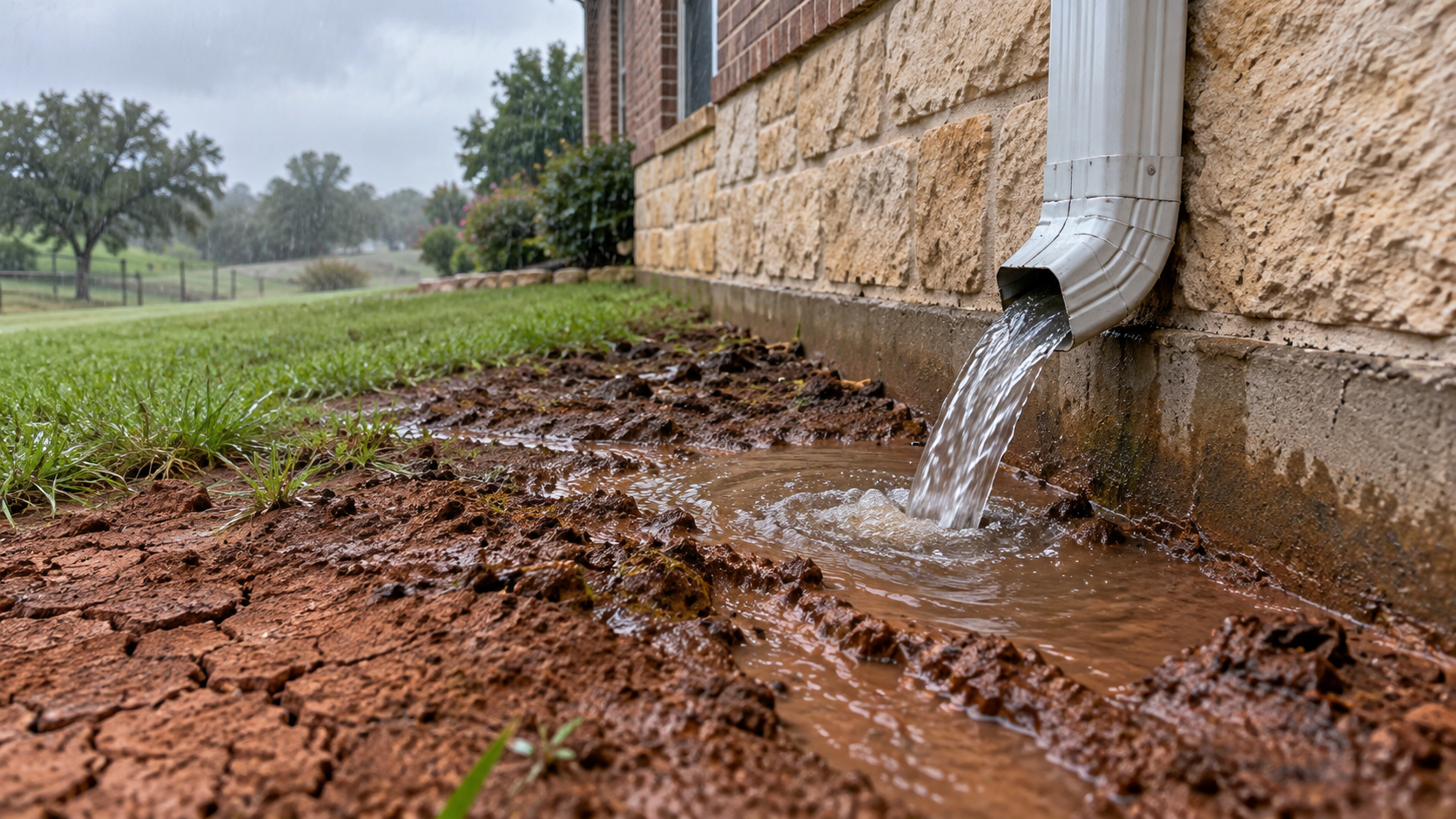
Clearing the full gutter run and checking downspout flow keeps water moving away from the home instead of pooling near the foundation. That last part is not a side detail here — pooling water next to a slab is the expensive failure that a cheap gutter problem turns into.
A Maintenance Schedule That Actually Prevents This
Most sagging is preventable, and preventing it is much cheaper than correcting it.
Twice a Year, Minimum
Clear the gutters and check flow. Spring after the seed and blossom drop, and fall after the leaves come down. Lots under heavy tree cover near the river need more than twice.
Every Summer
Walk the perimeter and sight down each run against the roofline while the gutters are dry and empty. You are looking for any deviation from a straight line. Note where it is and how long it has been getting worse.
After Any Significant Storm
Look for new low spots, fresh separation at seams, and downspouts knocked loose. Damage found in the week after a storm is a repair. The same damage found a year later is often a replacement.
Every Few Years
Have the fascia checked properly by someone who will probe it rather than glance at it. Fascia rot is silent, progressive, and the single most expensive thing that hides behind a gutter.
Repair or Replace
Short version, because this deserves its own treatment and got it separately: isolated problems on a sound system are repairs. Systemic problems, or repeated failures in the same places, are replacements.
A single sagging section with good fascia and intact metal elsewhere is a gutter repair. A run that has been patched three times, sits out of pitch along its length, and has softened fascia behind it is past that point — when an older Glen Rose home's gutters are past the point of repair, a right-sized seamless system gives the roofline a clean, working replacement.
The decision is made at the house, with the fascia probed and the slope measured. Anyone willing to tell you which one you need over the phone is guessing.
Frequently Asked Questions
Why are my gutters pulling away from the house?
Almost always fasteners or fascia. Either the screws and spikes have worked loose in holes that no longer grip, or the fascia board behind the gutter has softened and nothing fastened to it can hold. Both are common on older homes and both get worse with moisture exposure.
Can I fix a sagging gutter myself?
You can push a section up and add a hanger, and on a low single-story run with sound fascia that may hold. What you cannot do from a ladder is determine whether the fascia is sound or whether the run is out of pitch, and those are the two causes that make a DIY fix temporary.
How do I know if my gutter slope is wrong?
Look for standing water in dry weather. A gutter still holding water two days after rain, with no clog present, is a slope problem. A dirt or mineral line sitting lower than the rest of the run is the same signal.
Why does my gutter leak at the seam?
Because the joint moved. Sealant does not stretch, so when a run sags or shifts, the seam separates. Resealing it addresses the leak but not the movement that caused it, which is why resealed seams often reopen.
Do sagging gutters mean I need new gutters?
Not usually. Sagging is a hardware and fascia problem far more often than a metal problem, and both can be corrected on an otherwise sound aluminum system. Repeated failures in the same spots, or a run that is out of pitch along its whole length, are a different matter.
How often should gutters be cleared?
Twice a year is the floor — spring and fall. Lots with heavy tree cover, including many properties near the Paluxy River, need it more often. Anyone telling you once a year is enough under mature oaks has not been on that roof.
How long do aluminum gutters last?
Longer than the hardware holding them up, in most cases. Aluminum does not rust, so failures are mechanical rather than material. The practical exception is a section that has been bent and re-straightened repeatedly, since aluminum holds permanent deformation.
Will gutter guards stop the sagging?
They reduce one cause of it. Guards cut down debris accumulation, which cuts down standing-water weight, which is the most common contributor. They do nothing for bad slope, loose fasteners, or rotten fascia.
Should I wait until fall to fix a sagging gutter?
No, and summer is the better time on purpose. The gutters are dry, the damage is visible, and the work gets done before the next heavy rain instead of during it. Waiting means whatever water is escaping keeps running where it should not.
Can a sagging gutter damage my foundation?
Indirectly, yes, and this is the reason to take it seriously. A sagging run discharges water in the wrong place, and pooling water next to a slab is a far more expensive problem than the gutter that caused it.
Get It Looked At While It Is Dry
Sagging gutters do not recover on their own, and every season they stay crooked is another season of water going somewhere it was not meant to go.
Call Granbury Gutters at (817) 326-3682 for a free on-site evaluation. We are open Monday through Friday from 8 to 5 and Saturday from 9 to 1, closed Sunday. We are BBB Accredited and rated 4.9 out of 5 on Google.
We are a Granbury-based team, not a call center dispatching to whoever is available — the same people who look at your gutters do the work on them. More about us, and we serve Glen Rose and the surrounding area from our shop at 1019 Davis Road in Granbury.
We will probe the fascia, measure the slope, and tell you which of the five causes you are actually dealing with — then price the fix that addresses it rather than the one that hides it for a season.