Frozen Gutters, Sagging Runs, and Fascia Rot: Winter Gutter Damage in Granbury, TX
A North Texas winter is short, but it is what finally breaks gutters that were already weak. What frozen gutters do, why runs sag, how fascia rot starts, and whether heat cable is worth it here.
Have a gutter question about your Granbury home?
Call (817) 326-3682North Texas does not get a long winter, and that is exactly why gutters fail here. A handful of hard freezes a year does not sound like much, but a cold snap rarely creates the problem. It finishes one that was already there.
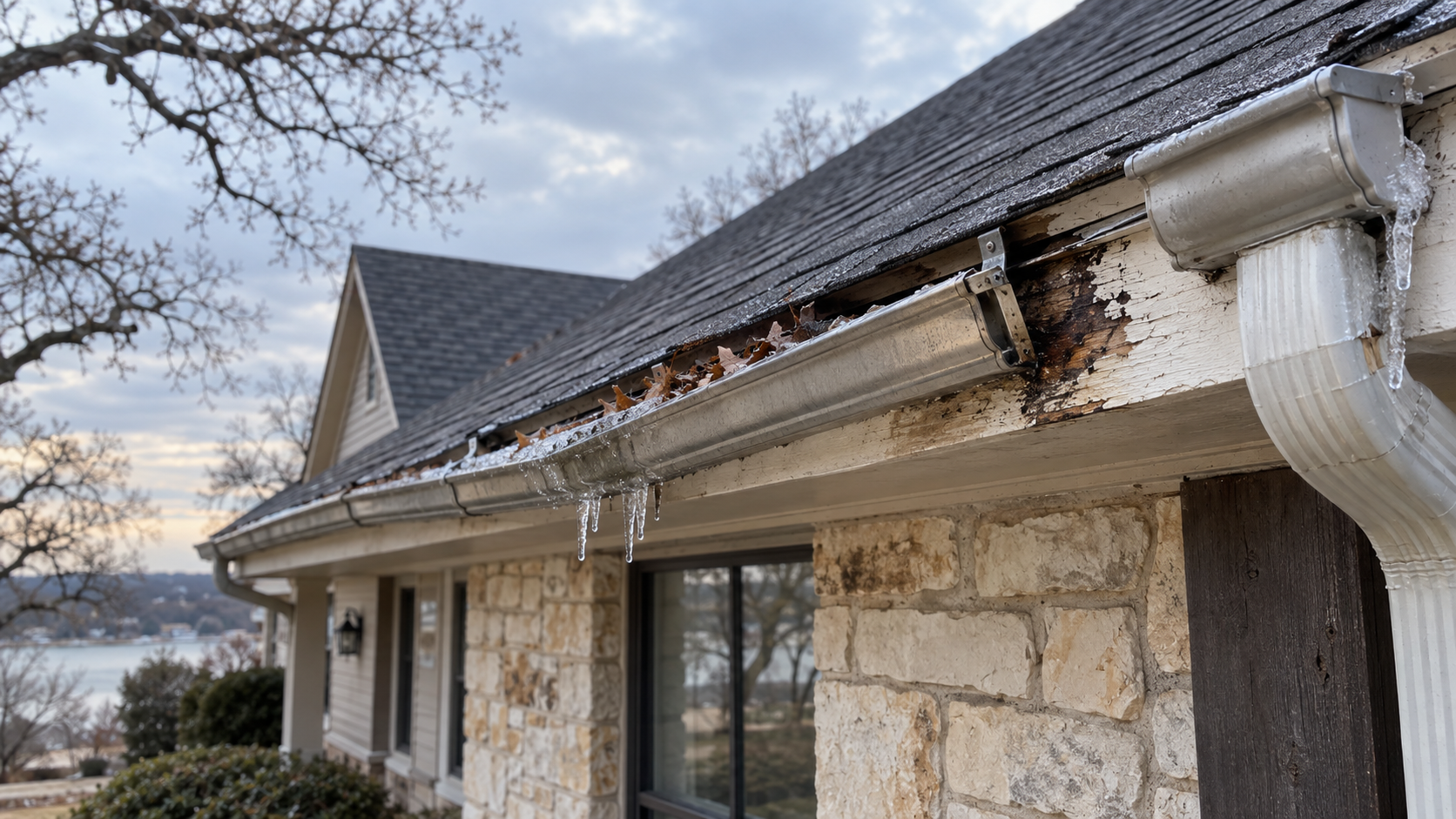
A gutter packed with fall debris holds water instead of moving it. When that water freezes, the trough is suddenly carrying several times the weight it was hung to hold, and it carries it where gutters are weakest: at the hangers and at the fascia board behind them. Homeowners in Granbury usually notice in January, after the thaw, when one section is sitting visibly lower than the rest, or a seam that never leaked before is dripping every time it rains.
This guide covers what a freeze actually does to a gutter system in Hood County, what you can check from the ground, and which winter fixes are worth paying for here versus which ones are sold to people who live a thousand miles north. If something looks wrong along your roofline, call us at (817) 326-3682.
Why a Short Texas Winter Is Still Hard on Gutters
- Ice does not drain. Rain passes through in minutes. Ice sits in the trough loading the hangers continuously for days.
- Freeze and thaw cycles work fasteners loose. Water expands as it freezes, pushes against seams and fastener holes, then relaxes. North Texas cycles above and below freezing far more often in a single winter than colder states do, and that repeated movement is what fatigues a system.
- Clogged gutters are the actual culprit. A clean, properly pitched gutter drains before it can freeze. A clogged one is a trough of standing water waiting for the temperature to drop.
- Downspouts freeze from the bottom up. Once the outlet is blocked, the entire run stays full, and the weight has nowhere to go.
- Our freezes arrive with wind. Wind load on a gutter already heavy with ice is what pulls spikes and hangers out of the fascia.
Frozen Gutters: What Actually Happens
Water weighs about eight pounds per gallon, and ice weighs effectively the same. A twenty-foot run holding even a few inches of frozen slush and debris is carrying well over a hundred pounds that the hangers were never spaced to support.
The failure sequence is almost always the same:
- Debris blocks the outlet, so the trough holds water.
- The water freezes, and the weight multiplies.
- A hanger loses its grip on the fascia, or a fastener pulls out.
- That section drops, creating a permanent low spot.
- The low spot holds water year-round, so the sag deepens with every rain.
- Pitch is lost, and the gutter now overflows in ordinary weather.
By the time a homeowner calls, the freeze is usually two months gone and the visible symptom is overflow in a spring storm. The damage was done in January.
Do We Get Ice Dams in North Texas?
Rarely, and this matters because most winter gutter advice online is written for Minnesota.
A true ice dam needs a deep, persistent snow load on the roof, heat escaping through the attic to melt the underside of that snowpack, and sustained sub-freezing air at the eave to refreeze the meltwater. Hood County gets the cold but almost never the sustained snowpack. What we get instead is simpler and more common:
- Frozen standing water in clogged troughs, which is a weight problem, not a meltwater problem
- Ice at a single overflow point, where water has been spilling over a low spot and freezing in layers on the fascia, soffit, or siding
- Icicles at a blocked outlet, which look dramatic but are really just telling you the downspout is plugged
- Refreeze at the discharge, where a downspout dumps onto a walk or driveway and builds a hazard
The practical difference is where the fix goes. Ice dams are an attic insulation and ventilation problem. What we see here is a drainage and debris problem, which is fixable at the gutter.
If you see water staining on the ceiling or wall below an exterior wall after a freeze, that is worth a roofer's opinion as well as ours.
Is Gutter Heat Cable Worth It in Hood County?
Usually not, and we would rather say so than sell it.
Heat cable is a real product that solves a real problem in climates with persistent snow and ice loading. In North Texas it tends to be an expensive workaround for something cheaper:
- If the trough is clogged, heat cable melts a channel through debris that should not be there. The debris is still there in March.
- If the fascia is soft, you are anchoring more hardware into wood that cannot hold what it already has.
- If the pitch is wrong, cable does nothing about the standing water that caused the sag.
- It needs power at the roofline, it runs on electricity every cold night, and it has a service life.
Cleaning the system, correcting pitch, repairing fascia, and making sure downspouts discharge properly will outperform heat cable here for less money. Fascia and trim damage should be repaired first in any case. If you have one specific chronic problem spot after all of that is addressed, it becomes a reasonable conversation.
What to Look For After a Freeze
All of this is visible from the ground. Do not get on a ladder in winter.
- A visible sag or dip in a run that used to be straight
- Any gap between the back of the gutter and the fascia board
- Spikes or hanger heads standing proud of the gutter face, or backed out entirely
- Seams that have separated, or a steady drip at a joint after the thaw
- Downspouts that look bulged, split at a seam, or pulled loose from the wall
- Water stains, streaking, or peeling paint on siding directly below the gutter line
- Stained or darkened fascia, or paint blistering along the board
- Icicles or ice concentrated at one spot, which means water is pooling there
- Mulch or soil washed out in one place along the foundation
- Granules or grit in the trough, visible from an upstairs window
One dripping seam is worth a call. Water running down the same spot on your fascia every time it rains is what turns a cheap repair into a replacement.
Sagging Runs: Why They Do Not Fix Themselves
A sagging gutter is not cosmetic. It is a section that has stopped draining, and it gets worse on its own because the standing water it now holds keeps pulling it down.
Sagging comes down to three causes, and telling them apart determines the fix:
- Hanger failure. Fasteners have loosened, corroded, or pulled out from age, wind load, or ice buildup. Spacing may also have been too wide from the start. This is the most common cause and the easiest correction.
- Fascia rot. The hangers are fine but the wood behind them is soft and no longer grips a fastener. Re-hanging into rotted wood fails again within a season.
- Lost pitch. The run is intact but no longer falls toward the outlet, so water pools mid-run and the weight creates a permanent low spot.
Pushing a sagging section back up and driving in a longer screw is the fix homeowners try first. It holds for a few weeks. If the fascia is soft or the pitch is wrong, the same section drops again, and each attempt leaves another hole in the board. Our gutter repair work starts by identifying which of the three you actually have.
Fascia Rot: The Problem Behind the Problem
The fascia is the horizontal board along the roof edge that your gutters hang from. It is the most commonly overlooked part of a gutter problem, and in winter it is the part doing the suffering.
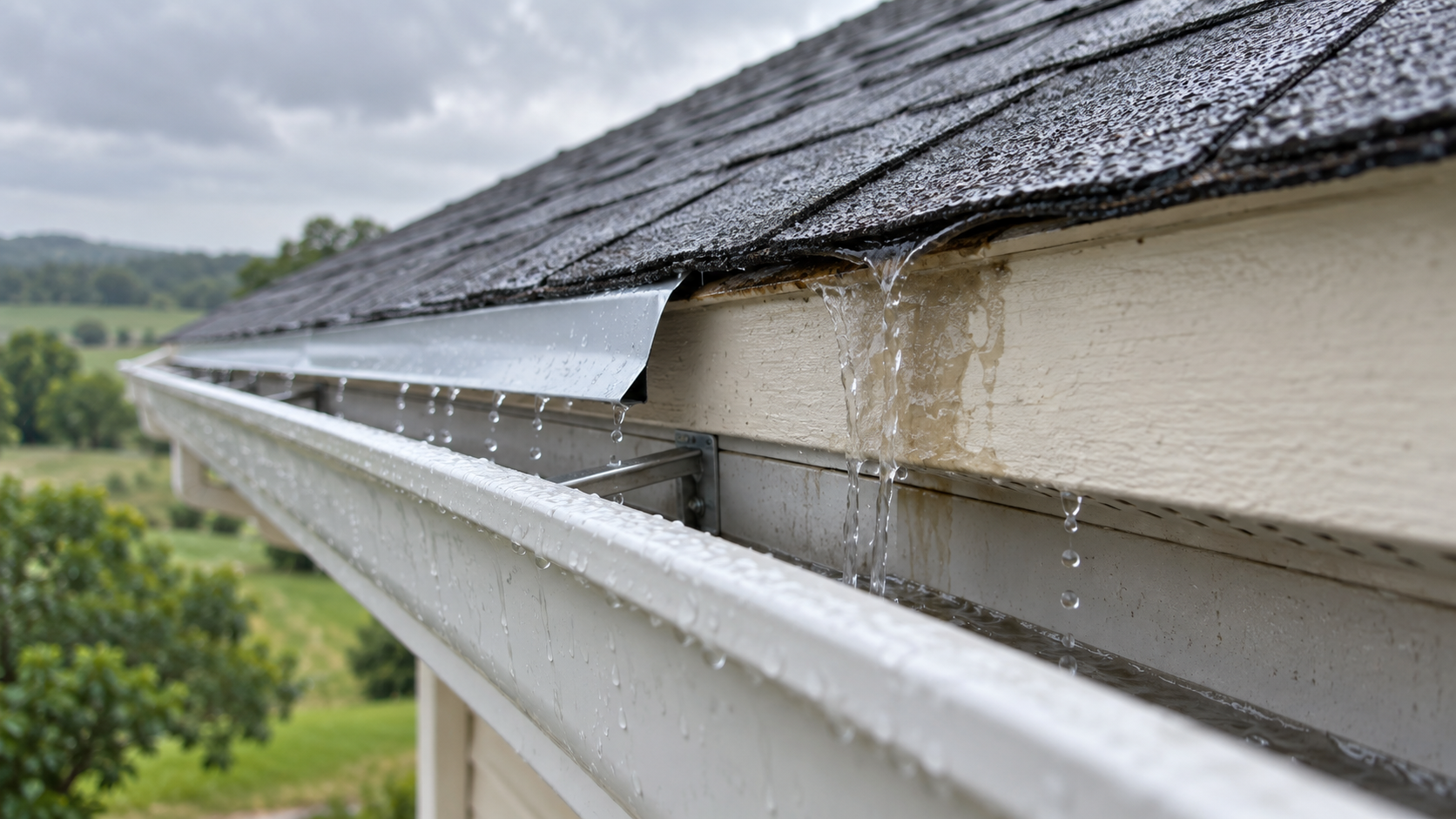
When a gutter overflows or leaks at the back, water runs down the face of that board and soaks in. Paint blisters, then the wood darkens, then it goes spongy. Soft fascia cannot hold a fastener, which means the gutter loosens further, which means more water hits the board. It is a loop that accelerates.
Signs the fascia is the real issue:
- A screwdriver or fingernail presses into the board with little resistance
- Paint is blistered, peeling, or discolored in a band below the gutter
- The gutter has been re-secured before and dropped again
- You can see daylight or a gap between gutter and board
- Fastener holes look enlarged or the heads sit loose
Fascia repair has to come before gutter work, not after. Hanging a new seamless run on rotted wood wastes the new gutter. We point out wood rot and soft spots during the estimate so you know what the sequence needs to be, and whether it is a trim carpenter's job before ours.
Leaking Seams and Why Sealant Is a Temporary Fix
Every joint in a sectional gutter system is a potential leak, and freeze-thaw cycling is what finds them. Water in a seam expands as it freezes and works the joint apart a fraction at a time.
A tube of sealant from the hardware store will stop a seam leak. It will stop it for a season, maybe two. What it does not do is address why the joint is moving, and it has to be applied to a clean, dry, above-freezing surface to bond at all, which is rarely the case on the day someone notices the drip in January.
This is where seamless matters. Seamless aluminum gutters are formed on-site to the exact length of each section, so a straight run has no mid-run joints to separate. Joints only exist at corners and outlets, where they can be properly handled. Fewer seams is simply fewer places for a freeze to find a weakness.
If your current system is sectional and you are sealing the same joints every year, the sealant is costing you more in time than the run is worth.
Gutter Pitch: The Thing Almost Nobody Checks
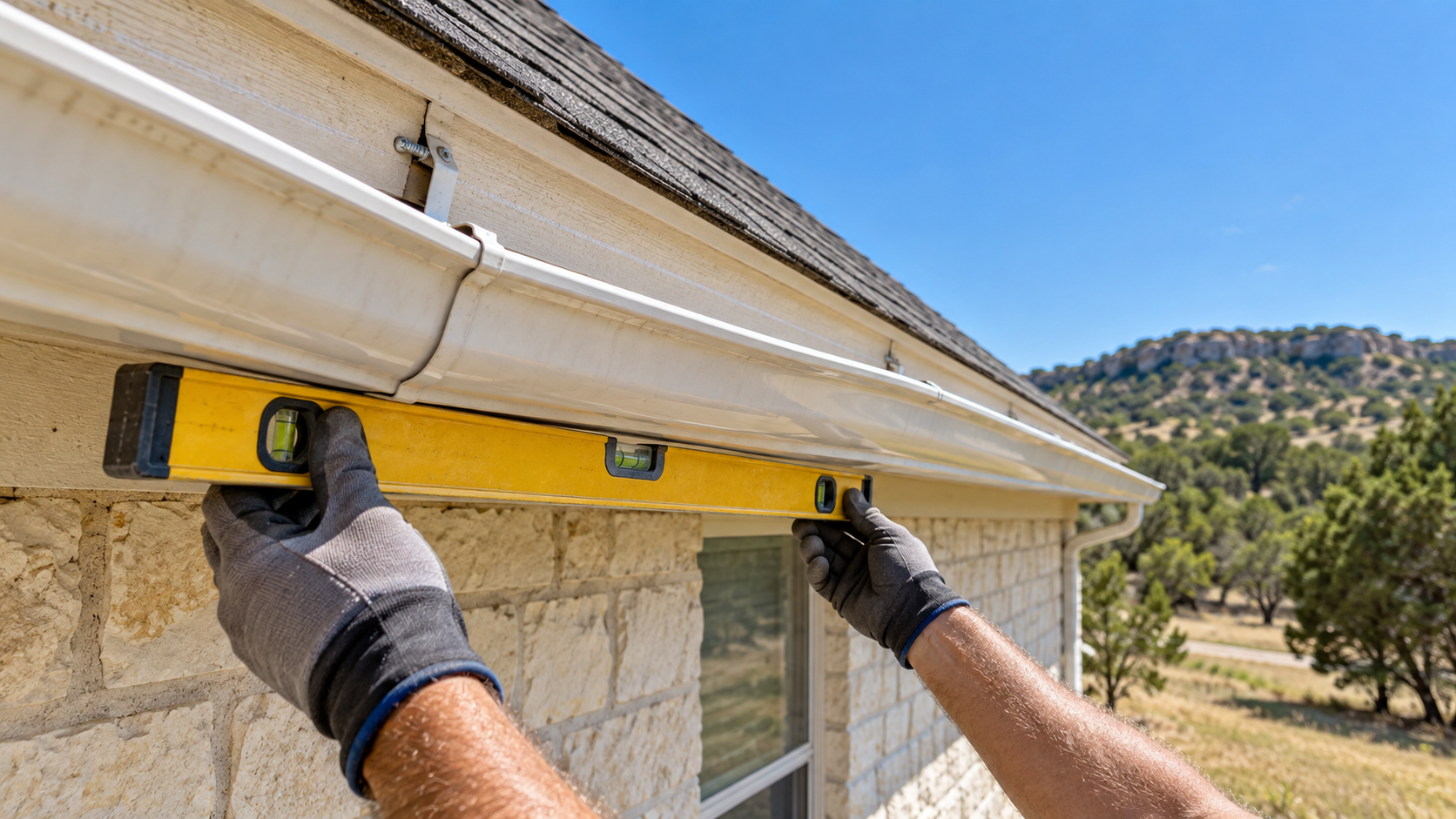
Gutters are not supposed to be level. They need a deliberate, slight fall toward the downspout so water keeps moving and nothing sits still.
Pitch is invisible from the ground until it fails, and then it explains everything:
- Standing water in a section long after the rain has stopped
- A tide line, silt line, or dirt ring inside the trough
- Mosquitoes or plant growth in one spot
- Overflow at the same place every storm while the rest of the run is fine
- Ice forming mid-run rather than at the outlet
Lost pitch is both a cause and a symptom. A sag destroys pitch, and bad pitch creates the standing water that causes the next sag. Correcting it means re-hanging the run to a proper fall, which is repair work, not replacement, as long as the aluminum is still sound.
Downspouts, Discharge, and Winter Foundation Damage
Downspouts are where winter gutter problems become foundation problems. A downspout freezes from the bottom, and once the outlet is blocked the whole run above it stays loaded.
Two separate failures happen here:
- The downspout itself. Trapped water freezing inside can split a seam or bulge the pipe. Split downspouts leak against the wall for the rest of the year, soaking siding and trim.
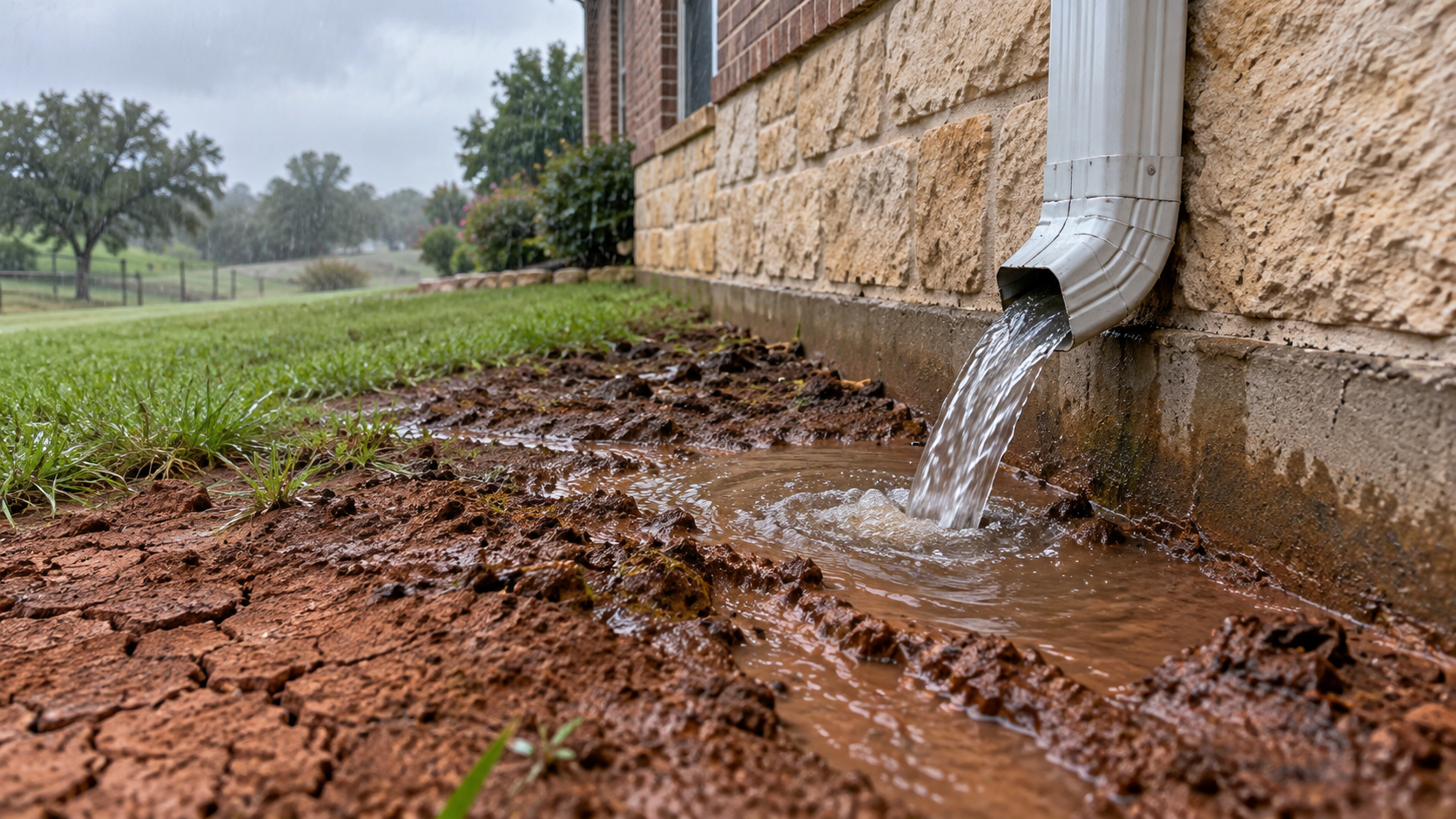
- The discharge point. Even a perfectly working downspout does damage if it dumps against the house. In winter that water saturates soil at the foundation, then freezes, and expanding saturated soil pushes against the foundation wall.
North Texas clay soil makes this worse than it sounds. Our soils swell when saturated and shrink when they dry, and repeatedly loading the soil at one corner of the house with roof runoff is exactly the cycle that moves a slab.
We reroute, extend, or re-secure downspouts so water discharges well away from your foundation. It is one of the least expensive corrections available and one of the most consequential.
Check where yours end up. If a downspout empties into a flower bed against the wall, or onto a walkway where it refreezes, that is worth addressing before the next freeze.
What We Check During a Free On-Site Evaluation
Winter damage is easy to misdiagnose from the ground, because the visible symptom and the actual cause are often at opposite ends of a run. Our evaluation is free and done on-site, and we go through the system in order:
- Every hanger and fastener along each run, for grip and spacing
- Condition of the fascia board behind the gutter, probing for soft spots and rot
- Actual pitch of each run, measured rather than eyeballed
- Every seam, corner, and end cap for separation or active leaking
- Downspout condition, attachment, and whether outlets are clear
- Where each downspout discharges, and how far from the foundation
- Debris load in the trough and the condition of any existing guards
- Overflow evidence on fascia, soffit, siding, and at the foundation
- Whether the aluminum itself is sound or has been deformed
You get an honest on-site estimate at the end of it, and a clear answer on whether you are looking at a repair or a replacement. We are a Granbury-based team, not a call center dispatching to whoever is available, so the person who looks at your roofline is the person who explains it.
Repair or Replace After Winter Damage
Most winter damage is a repair. The aluminum in a gutter system outlasts the hardware holding it up, so a freeze usually breaks the cheap part.
Our rule is straightforward: if the aluminum itself is still sound and the problems are limited to hangers, seams, pitch, or downspouts, repair is usually the more cost-effective option.
Repair territory:
- Loose, missing, or pulled-out hangers and fasteners
- One or two sagging sections on an otherwise good system
- Separated seams or corners
- Split, detached, or poorly routed downspouts
- Pitch correction on an intact run
- Clearing a blocked outlet
Replacement becomes the better value when:
- The aluminum is dented, crushed, or deformed along significant lengths
- Multiple runs are sagging and the fastener holes are worn out
- You are repairing the same sections every year
- The system is undersized for the roof and overflows even when clean
- Sectional gutters have so many failing joints that sealing them is a standing chore
A gutter replacement is worth pricing alongside the repair when you are in that second list, because the repair cost on a worn-out system stops making sense quickly. Most residential homes are fitted with new seamless gutters in a single day.
What Not to Do in Winter
- Do not climb a ladder onto frozen ground or a frozen roof edge. This is the single most dangerous DIY job in the house, and the ground you are footing the ladder on is not stable when frozen.
- Do not chip or hammer ice out of a gutter. Aluminum dents and punctures easily, and you will turn a debris problem into a replacement.
- Do not pour hot water or salt into gutters. It refreezes further down the run, and salt corrodes fasteners and aluminum and kills whatever is planted below the discharge.
- Do not pressure wash a frozen or loose gutter. The force is enough to finish off a hanger that is already compromised.
- Do not seal a seam in freezing weather. Sealant needs a clean, dry, above-freezing surface to bond. Applied cold, it peels.
- Do not re-screw a sagging run into soft fascia. It buys weeks and leaves another hole in the board.
- Do not ignore one dripping joint. A joint that drips in January is a joint that overflows in April.
Getting Ahead of Next Winter
Winter damage is almost entirely preventable, and the prevention happens in the fall rather than in January.
- Clean before the first freeze, not after. A clear, properly pitched gutter drains and cannot freeze full. Our gutter cleaning and inspection service handles the debris and catches loose hangers while they are still a small fix.
- Have the system checked in late fall. Hangers, seams, and pitch are cheap to correct in October and expensive to correct after a run has dropped.
- Confirm downspouts are clear and discharge away from the house. Test it with a hose before the weather turns.
- Deal with fascia before it goes soft. Paint and sealed trim resist water. Bare or blistered wood absorbs it.
- Consider guards if you have heavy tree cover. Gutter guards substantially reduce the debris that causes a trough to hold water in the first place, and can usually be added to existing gutters if the condition and profile allow. No system is fully maintenance-free, so periodic inspection is still worth doing.
- Trim branches overhanging the roofline. Less debris in, less debris to remove.
Homes around the lake and under mature pecan and oak canopy in Granbury and the surrounding Hood County communities collect the most debris and see the most freeze damage. Those are the systems worth looking at every fall.
Frequently Asked Questions
Can frozen gutters really damage my house?
Yes, and the damage is usually indirect. The ice itself pulls hangers loose and can dent or split components, but the lasting damage comes afterward: a sagging run overflows for the rest of the year, and that water goes into fascia, soffit, siding, and the soil at your foundation. A freeze that lasts three days can cause a problem you are paying for in June.
Should I remove ice from my gutters myself?
- Chipping at ice punctures and dents aluminum, hot water refreezes further down the run, and salt corrodes fasteners and the gutter itself. Winter ladder work on frozen ground is genuinely dangerous. The right move is to wait for the thaw and then have the system evaluated for what the ice loosened.
Why is my gutter sagging after a freeze?
Because it was holding frozen water, and the weight overcame whatever was holding it up. The cause is either fastener failure from age, wind load, or ice buildup, or fascia board rot that no longer holds hangers securely. Which one it is determines whether the fix lasts, which is why simply pushing the section back up and driving in a screw tends to fail again.
Is gutter heat cable worth installing in North Texas?
For most Hood County homes, no. Heat cable is designed for climates with persistent snowpack and true ice damming. Here, cleaning the system, correcting pitch, repairing fascia, and fixing downspout discharge solve the same symptoms for less money and with nothing to power or maintain. If one specific spot remains a chronic problem after all of that, it is worth discussing.
How much does fascia board repair cost?
It depends entirely on how far the rot has traveled and how much of the board is affected, so we will not quote a number without seeing it. What we can tell you is that fascia is repaired before gutter work, not after, because new gutters hung on soft wood fail. We point out wood rot and soft spots during the free on-site evaluation so you know the sequence and the scope before committing to anything.
Do I need to replace my gutters or can they be repaired?
If the aluminum itself is still sound and the problems are limited to hangers, seams, pitch, or downspouts, repair is usually the more cost-effective option. Replacement makes more sense when the aluminum is dented or deformed across significant lengths, when several runs are sagging with worn fastener holes, or when you are repairing the same sections every year.
Why does my gutter leak at the seam only sometimes?
Seams leak when they move, and freeze-thaw cycling moves them. A joint can be tight in mild weather and open slightly after a hard freeze works the sealant loose, so the drip appears to come and go. It will not reseal itself. Seamless aluminum gutters are formed on-site to the exact length of each section, which removes mid-run joints entirely.
When is the best time to have gutters cleaned in Granbury?
Late fall, before the first hard freeze, is the single most valuable cleaning of the year, because it removes the debris that would otherwise hold water through a freeze. Homes under heavy tree cover generally need more than one cleaning a year, with the second in spring after seed and pollen drop.
Do gutter guards prevent freeze damage?
They reduce the main cause of it. Guards keep the debris out that turns a trough into a basin of standing water, and a gutter that drains does not freeze full. They are not a complete solution: no system is fully maintenance-free, and guards do not correct bad pitch, loose hangers, or rotted fascia. Fix the structural issues first, then guards keep the system working.
Get Your Gutters Looked At Before the Next Freeze
If a run is sagging, a seam is dripping, or you can see a gap between your gutters and the fascia, it is worth having someone look at it now rather than after the next storm.
Call Granbury Gutters at (817) 326-3682 to schedule a free on-site evaluation. We are open Monday through Friday, 8:00 AM to 5:00 PM, and Saturday, 9:00 AM to 1:00 PM. Give us a call during business hours and we will come look at your roofline, tell you honestly whether it is a repair or a replacement, and give you a straight estimate.
We are based at 1019 Davis Road in Granbury and serve Granbury and the surrounding Hood County communities. We are a BBB Accredited Business, and we are a local team rather than a call center dispatching to whoever is available.